

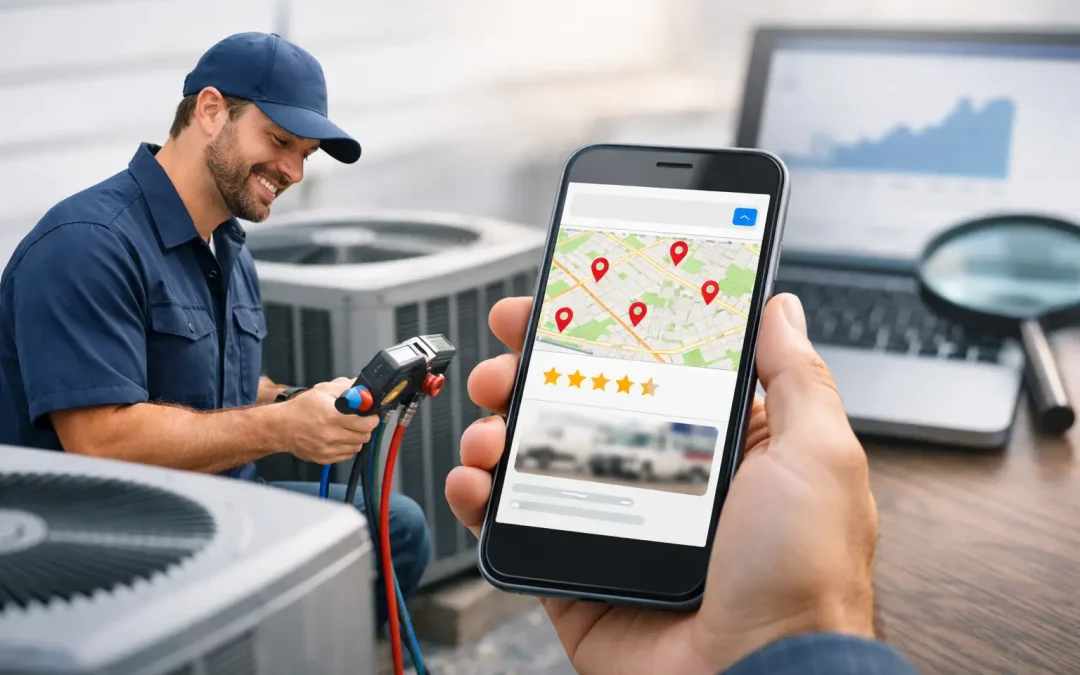
When a homeowner’s air conditioner quits during a July heat wave, they are not researching marketing claims. They are searching for an HVAC company near them, checking the map, scanning reviews, and calling the business that looks capable of showing up fast. HVAC Google Business Profile optimization puts your company in that decision path – but only when it is treated as a revenue system, not a one-time listing task.
A complete profile can improve local visibility. That alone does not build a better HVAC business. The real objective is qualified calls, booked estimates, dispatched technicians, and profitable repeat customers. If your profile creates visibility but your team misses calls, responds slowly, or sends searchers to a weak website, the marketing system has a leak.
Why HVAC Google Business Profile Optimization Matters
Google’s local map results carry unusual weight for HVAC companies because the search often has immediate urgency. A homeowner searching for furnace repair, AC repair, heat pump installation, ductless mini-split service, or emergency HVAC help usually has a defined problem and a short list of providers. The businesses appearing prominently in the map pack receive a disproportionate share of attention.
Google generally evaluates local visibility through relevance, distance, and prominence. You cannot control how close a customer is to your office. You can control whether Google clearly understands your services, service area, business category, reputation, and real-world activity. You can also control whether a prospect sees enough proof to choose you over the contractor listed beside you.
This is why chasing a higher map ranking without looking at calls and booked jobs is shallow marketing. A listing that ranks for broad terms but attracts work outside your ideal service area, low-value inquiries, or price-only shoppers can create activity without creating margin. The profile should support the markets, services, and job types your operation is built to win.
Build a Profile That Matches How Customers Search
The foundation is accuracy. Your business name, phone number, website, hours, service area, and primary category must match reality and remain consistent wherever your company appears online. Do not add extra keywords to the business name unless they are part of the legal, customer-facing name. That shortcut can trigger edits, suspensions, and unnecessary recovery work.
Choose categories with discipline
For most full-service contractors, “HVAC contractor” is the logical primary category. The right secondary categories depend on your actual offerings. An air conditioning contractor, heating contractor, furnace repair service, or commercial refrigeration service category may help clarify specialized work, but only if you genuinely provide it.
Categories are not a place to claim every possible job. A focused category strategy helps Google connect your company to relevant searches and helps your team attract the kind of calls it can serve well. If you primarily want replacement projects and maintenance agreements, your profile and supporting content should not be built around emergency-only messaging.
Write for homeowners, not algorithms
Your business description should quickly establish where you work, what you do, and why a homeowner or facility manager should trust your team. Mention core services naturally: repair, installation, replacement, maintenance, indoor air quality, heat pumps, and emergency service if available. Include meaningful operational proof such as licensed technicians, years in business, financing availability, or same-day dispatch when those claims are true.
Avoid a block of city names and search phrases. It reads poorly, creates little trust, and rarely solves the actual conversion problem. A homeowner wants confidence that you service their equipment, communicate clearly, and can provide a practical next step.
Set hours and service areas carefully
Incorrect hours are expensive for an HVAC company. If you advertise 24/7 availability, someone must be prepared to answer or promptly return those calls. If your office is closed but your emergency line is staffed, make that process clear across the profile, website, and call handling workflow.
For service-area businesses, define the markets you can reach profitably. Covering every city within 75 miles may look ambitious, but it can create long windshield time, scheduling friction, and weak service quality. Market domination starts with operational capacity, not a giant radius on a map.
Turn Profile Visits Into Booked HVAC Jobs
A Google Business Profile is often a prospect’s first impression, but it should not be the final destination. The profile needs a clear route to call, request service, book an estimate, or learn about the exact service they need. That route must work on a phone, where most local searches happen.
Your website landing pages matter here. A person searching for furnace installation should land on a page that explains your replacement process, trust signals, financing options if offered, and a direct way to request an appointment. Sending every visitor to a generic homepage adds friction at the moment of highest intent.
Call tracking can help identify which calls come from the profile and whether those leads become jobs. Use it carefully. Your core business number should remain consistent, and your tracking setup should preserve accurate attribution without confusing customers or weakening listing consistency. The point is not prettier reports. The point is finding out whether map visibility is producing revenue.
Response speed is another overlooked conversion factor. An HVAC lead that reaches voicemail during a breakdown may call three competitors before your dispatcher gets back to them. A disciplined lead-response process, supported by text follow-up and appointment workflows, protects the value of every local search opportunity. Near Me Website Marketing approaches this as one connected growth system: visibility, response, booking, and follow-up must work together.
Reviews Are Operational Proof, Not a Vanity Metric
Reviews influence both trust and local prominence, but the quality of the process matters more than asking everyone once a quarter. A steady flow of recent, honest reviews tells future customers that your business is active and accountable. It also gives them details that generic five-star ratings do not.
Build a review request into the completed-job workflow. The best time is usually after the customer has experienced the result: cool air restored, a new system installed cleanly, or a maintenance visit completed professionally. Make the ask easy, but never pressure customers, offer incentives for positive reviews, or filter requests based on whether you expect praise.
Respond to reviews in a timely, professional way. Thank customers by referring to the service experience without exposing private details. When a review is critical, do not argue in public. Acknowledge the concern, state your commitment to resolve it, and move the detailed conversation offline. Your response is written for the next homeowner reading the exchange.
Photos reinforce that same trust. Upload real images of branded vehicles, technicians, office signage, completed installations, maintenance visits, and equipment work. Stock images may look polished, but they do not prove that a local crew will arrive at the door. Update photos regularly so the profile reflects an active business, not a listing created years ago and forgotten.
Maintain the Signals Google and Customers Can Trust
Optimization is not a set-it-and-forget-it project. HVAC seasonality changes demand, staffing changes availability, and new services may change your priorities. Review the profile monthly and after any operational change. Check phone numbers, holiday hours, service areas, categories, appointment links, photos, customer questions, and recent reviews.
Use Google Business Profile posts selectively to support timely offers, maintenance reminders, financing announcements, or seasonal service priorities. A spring AC tune-up message and a fall furnace maintenance message make sense when they align with capacity and your broader campaign. Posts will not rescue weak fundamentals, but they can give an active profile another reason to earn attention.
Do not confuse activity with progress. Posting every week while ignoring unanswered calls, low review velocity, or inaccurate service information will not solve the bottleneck. Strategy before tactics means identifying the constraint that is limiting growth now, then fixing that constraint with the right process.
Measure What Changes the Business
Track more than ranking screenshots. Your scorecard should connect profile performance to calls, direction requests, website visits, appointment requests, lead quality, booking rate, average ticket, and closed revenue. For replacement-focused companies, track how many profile-generated opportunities become completed installs. For service-heavy companies, track whether local visibility fills the board with profitable work in the areas you want to serve.
Results vary by competition, proximity, review strength, website quality, and the credibility of your overall local presence. A newer company may need time to build the authority an established competitor has earned over years. An established company with a neglected profile may see faster gains once accuracy, reviews, conversion paths, and operational follow-up are corrected.
The right question is not, “Are we number one for every HVAC search?” Ask whether your profile is producing the right calls, your team is booking them fast, and the work supports the company you want to build. Treat your Google Business Profile like a working part of the business, and it can become one of the most dependable engines in your local growth plan.