

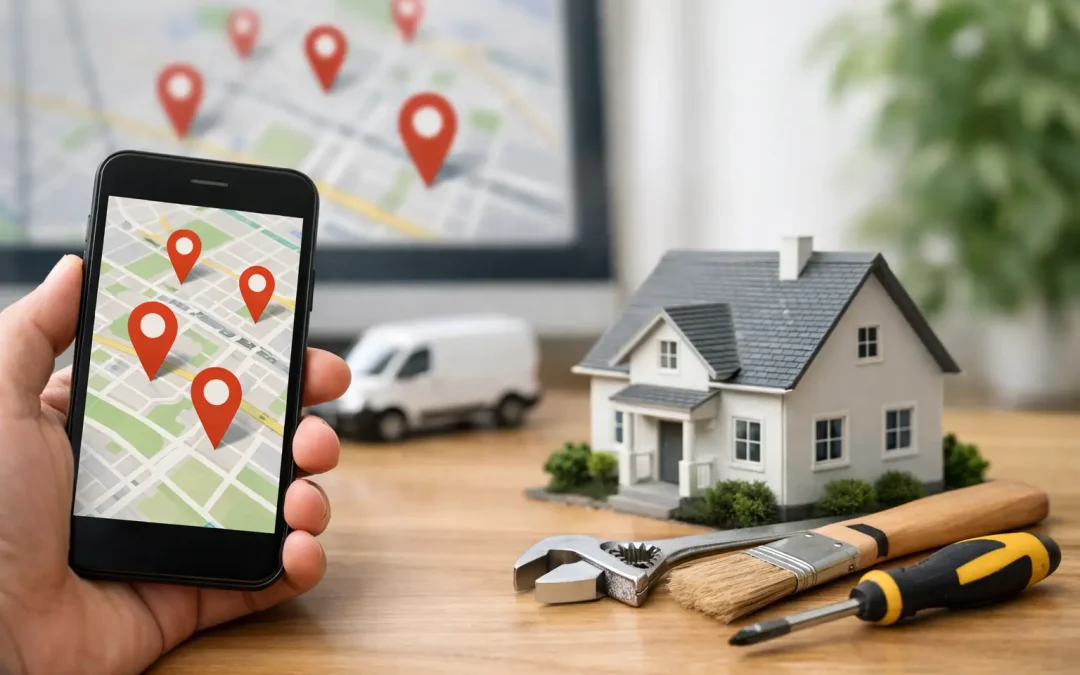
A homeowner with a leaking water heater is not comparing 20 contractors. They are searching, scanning the map results, checking reviews, and calling the company that looks credible and available. That is why learning how to improve map rankings matters for home service operators. Map visibility puts your business in front of high-intent prospects at the moment a problem needs to be solved.
But a top-three map position is not the finish line. If calls go unanswered, estimate requests sit in a shared inbox, or your website makes booking difficult, stronger rankings only expose operational leaks. The goal is qualified local visibility that turns into answered calls, booked appointments, completed work, and repeat customers.
How Google Maps Rankings Actually Work
Google does not publish a simple checklist that guarantees a map pack position. In practice, local rankings are influenced by three broad factors: relevance, distance, and prominence.
Relevance is how clearly Google understands what you do and where you do it. An HVAC company should not look like a generic “home services” business online. Its profile, website, service pages, photos, reviews, and business details should consistently show that it provides HVAC repair, replacement, maintenance, and related services.
Distance is the searcher’s location in relation to your verified business address or the area Google believes you serve. You cannot optimize your way around geography. A company in one suburb will usually have a harder time appearing for searches far outside its core market. This is where owners waste money chasing impossible citywide rankings instead of building density where crews can respond profitably.
Prominence is the trust Google sees around your business. Reviews, rating quality, local mentions, website authority, engagement, accurate business information, and real-world brand recognition all contribute. No single tactic carries the whole load. Map performance improves when these signals reinforce one another over time.
Build a Google Business Profile That Reflects the Real Business
Your Google Business Profile is a primary local visibility asset, not a listing to set up once and forget. It needs to accurately represent the business you operate today, including your services, hours, contact information, website, service area, and category selection.
Start with the primary category. Choose the category that most directly describes the core service that drives your business. A roofing contractor should generally be categorized as a roofing contractor, not a broad construction company. Secondary categories can support adjacent work, but adding every remotely related category muddies relevance and can create a profile that looks less credible.
Your services should be organized around the jobs customers actually search for and purchase. Be specific where the platform allows it. “Drain cleaning,” “panel upgrades,” “roof repair,” and “termite inspection” communicate more than vague catch-all labels.
Use your business description to explain who you serve, what you specialize in, and why customers choose you. Do not stuff it with city names or repeat keywords until it reads like a robot wrote it. The same rule applies to updates, photos, and responses to reviews. Clear information earns more trust than manufactured optimization.
Photos matter because customers use them to judge whether your company is established. Add genuine, high-quality images of branded vehicles, technicians, completed projects, equipment, office signage, and team members. For remodeling and roofing companies, before-and-after project photos can be especially persuasive. Keep them current. A profile full of outdated stock images tells a prospect very little about the company arriving at their home.
Earn Reviews That Build Trust and Local Relevance
Reviews influence map visibility, but their bigger value is conversion. A homeowner comparing three similar companies will often choose the one with recent, detailed feedback that answers practical questions: Did the technician arrive on time? Was the price explained? Was the work completed correctly? Was the home treated with respect?
Create a consistent review-request process tied to completed jobs. The best time to ask is when the customer has experienced the result and your team has confirmed satisfaction. This cannot depend on whether an office manager remembers at the end of a busy week. Make the request part of the closeout workflow through your CRM, field service platform, or automated follow-up system.
Do not buy reviews, pressure customers for five stars, or use review-gating tactics that only send happy customers to Google. These shortcuts can damage trust and violate platform policies. A steady flow of legitimate reviews from real customers is more valuable than a suspicious burst of generic praise.
Respond to reviews with professionalism. Thank customers specifically, reinforce the service provided, and address criticism without becoming defensive. A thoughtful response is not just for the reviewer. It is sales copy for the next homeowner evaluating your company.
Strengthen the Website Behind Your Map Listing
A Google Business Profile does not operate in isolation. Google evaluates the web presence connected to it, and customers often visit your website before calling. Your website should make it easy to verify your services, coverage area, credentials, phone number, and next step.
Build focused service pages for the work you want more of. An electrical contractor may need distinct pages for electrical repair, panel upgrades, EV charger installation, and generator installation. A generic page listing every service in a paragraph does not provide the same relevance or conversion value.
Location pages can help when they represent real market coverage and provide useful local context. They should not be thin copies with a city name swapped in every heading. If you serve Dallas, Plano, and Frisco, each page should reflect meaningful service information, project examples, local proof, and practical details for that market.
Keep your name, address, and phone number consistent across your profile and website. If you are a service-area business that does not receive customers at your location, follow Google’s guidelines for hiding the address. Do not create fake offices or virtual addresses to force visibility in neighboring cities. Those tactics are risky, temporary at best, and distracting from legitimate market-building.
Build Local Authority Beyond the Listing
Prominence grows when other credible sources validate your business. That can include accurate directory profiles, local chamber or trade organization listings, supplier relationships, community sponsorships, local news coverage, and legitimate mentions from organizations in your service area.
The objective is not to collect hundreds of low-quality listings. It is to ensure core business information is accurate and to earn signals that reflect a real, respected local company. For a home service brand, community involvement, project visibility, and a reputation for dependable work often produce better long-term authority than a pile of automated citations.
Watch for competitor spam, too. Map results can be distorted by keyword-stuffed business names, fake locations, duplicate profiles, and listings that do not follow Google’s rules. Document clear violations and report them through appropriate channels. Do not retaliate by copying the behavior. Clean, defensible assets are easier to scale than shortcuts that can disappear overnight.
Turn Map Visibility Into Booked Jobs
A better rank only creates an opportunity. Your operating system determines whether that opportunity becomes revenue. Track calls, form submissions, messages, booked appointments, estimates, sold jobs, and revenue by source. Without this data, it is easy to celebrate an increase in profile views while missing a decline in lead quality or close rate.
Speed matters. Many home service leads contact multiple companies, especially during emergencies. If your team takes an hour to return a missed call, the top map ranking may have delivered a lead to a competitor. Use call handling, text-back automation, scheduling workflows, and clear ownership so every inquiry gets a fast response.
Your map listing and landing experience should also match the customer’s intent. A search for “emergency plumber near me” needs a clear emergency response path, not a homepage that requires five clicks to find a phone number. For larger projects such as roofing replacement or remodeling, the path may involve estimate scheduling, financing information, proof of work, and a defined follow-up sequence.
Set Expectations and Improve in the Right Order
Map ranking improvements are rarely instant. Profile cleanup and conversion fixes can create early gains, while stronger review velocity, content depth, and local authority usually compound over months. Highly competitive markets require more consistency, more proof, and more patience than lightly contested rural areas.
Start by identifying the constraint. If your profile is incomplete, fix the foundation. If competitors have hundreds of recent reviews and you have 18 old ones, build a review engine. If ranking is improving but leads are not converting, repair call response and booking. Strategy before tactics prevents the common mistake of paying for more traffic before your business can efficiently handle the demand.
Near Me Website Marketing approaches map rankings as one part of a unified growth plan because visibility without follow-through is not growth. Build the profile, website, reputation, authority, and lead-response process to support one another. The company that consistently earns trust and responds first will have a far stronger business than the one that simply watches its position in the map pack.