

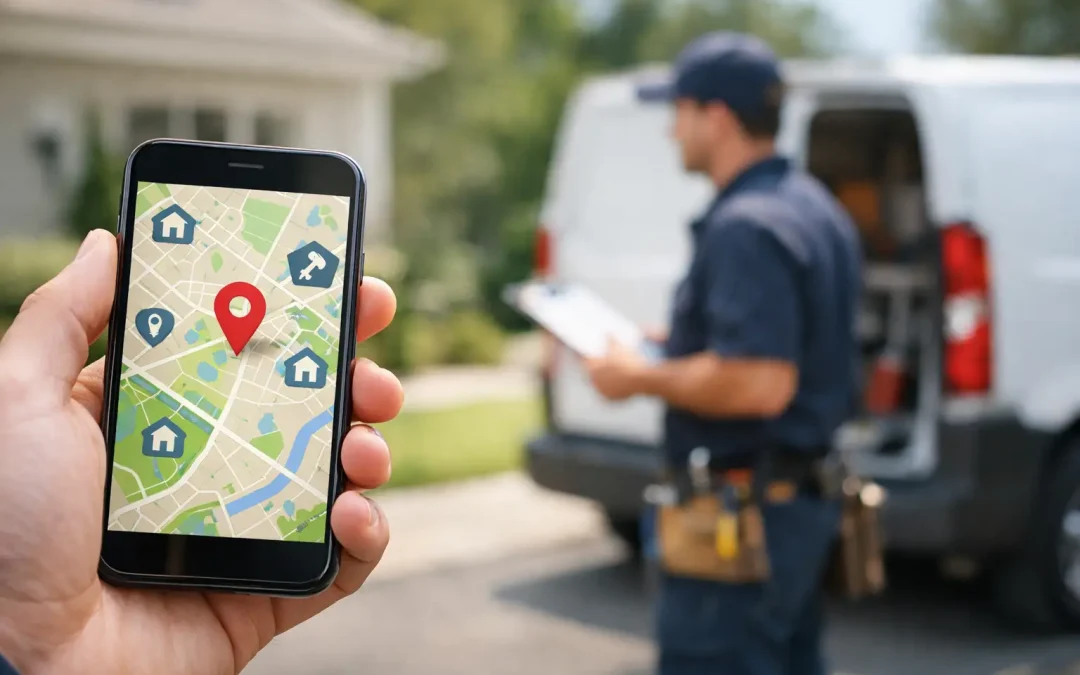
A homeowner with a leaking water heater is not researching marketing channels. They are opening Google Maps, comparing the first few companies, reading reviews, and calling the business that looks capable of solving the problem now. For home service companies, Google Maps is not simply a visibility tool. It is a high-intent lead source that can influence calls, estimate requests, booked jobs, and the reputation your company builds in a market.
The mistake is treating map rankings as the finish line. A top-three position that produces missed calls, weak reviews, or a slow estimate process does not create growth. The better objective is to build a local presence that earns trust quickly, routes leads into a reliable follow-up process, and supports profitable expansion across the service areas you can actually serve well.
How Google Maps Influences the Buying Decision
When a customer searches “AC repair near me,” “roofing contractor,” or “electrician in [city],” Google presents a small group of local businesses before many traditional website results. That map pack is valuable because the searcher is often close to taking action. They can see your rating, review volume, business hours, phone number, location, service details, and recent photos without visiting your website first.
That convenience creates a hard truth for established contractors: your company is being compared side by side with competitors in seconds. A strong brand can lose the call if its profile looks incomplete, its reviews are stale, or its listing creates uncertainty about whether it serves the customer’s neighborhood.
Map visibility also affects more than emergency work. Homeowners use it to shortlist remodelers, compare roof replacement companies, verify pest control providers, and find water treatment specialists. These longer sales cycles require more proof, but the same principle applies. Your map presence often forms the first impression before an estimator ever gets a chance to earn the job.
What Moves a Business Up in Google Maps
Google does not publish a simple formula, and no credible partner should promise a permanent number-one ranking for every search. Results shift based on the searcher’s location, competition, proximity, category, and search intent. Still, a disciplined local strategy focuses on the signals that consistently improve relevance and trust.
Relevance Starts With an Accurate Business Profile
Your Google Business Profile must clearly describe what you do and where you do it. That begins with the right primary category, appropriate secondary categories, complete contact information, accurate hours, and a service area that reflects your real operating footprint.
Category selection is especially consequential. An HVAC company should not dilute its main signal by choosing broad or unrelated categories simply because they sound adjacent. The primary category should align with the work you want to win most often and most profitably. Secondary categories can support legitimate services, but they should not turn the profile into a catch-all listing.
Services, business descriptions, photos, and updates add useful context when they are written for customers rather than stuffed with city names. If your company handles panel upgrades, emergency electrical repairs, and EV charger installations, make that clear. If you only serve certain cities for remodeling projects, say so plainly. Accuracy protects conversion rates as much as it supports visibility.
Prominence Is Earned in Public
Reviews are one of the most visible trust signals on Google Maps. A company with a high rating, a healthy volume of recent reviews, and thoughtful owner responses gives a homeowner more confidence than a business with a neglected profile.
The goal is not to pressure every customer or manufacture feedback. The goal is to create a repeatable review request process after a positive service experience. Technicians, office staff, and automated follow-up should work together so satisfied customers have a simple opportunity to share what happened.
Quality matters alongside quantity. A detailed review that mentions a fast AC repair, clean installation, fair communication, or professional crew helps future customers understand why they should choose you. Your response matters too. A calm, specific reply to praise or a legitimate complaint demonstrates accountability to everyone reading.
Distance Is Real, but It Is Not the Whole Strategy
Google Maps results are often influenced by how close the searcher is to your verified location. You cannot eliminate proximity by adding dozens of city names to a profile or setting up questionable virtual offices. Those tactics create risk and rarely build a durable market position.
Instead, build authority in the markets where your business can compete operationally. For a multi-city contractor, that may mean a properly managed location strategy, strong local proof, service pages that match real coverage, and targeted advertising for areas where organic map reach is limited. For a single-location company, it may mean dominating the nearby service radius before spreading resources thin across an entire metro area.
Turn Map Visibility Into Calls That Get Booked
A Google Maps strategy breaks down when it stops at the listing. The customer journey continues the moment someone taps call, requests directions, or visits your website.
First, make contact easy. Your phone number, hours, service details, and website experience should agree. If the profile says you offer 24/7 emergency plumbing but calls after 5 p.m. go unanswered, the listing is creating demand your operation is failing to capture. For many home service businesses, faster response is a larger revenue opportunity than another incremental ranking gain.
Second, measure what happens after the lead arrives. Track calls, form submissions, estimate requests, booked appointments, and closed revenue whenever possible. A map listing that generates 40 calls can look successful until you learn that half were missed, many were unqualified, and only a few became jobs. That is not a reason to abandon Google Maps. It is a reason to fix the bottleneck.
Third, prepare your team for the conversation. The dispatcher who answers a roofing lead or the customer service representative who handles a pest control inquiry needs a clear process for identifying the service need, confirming location, communicating next steps, and securing the appointment. Marketing creates the opportunity. Operational follow-through determines whether that opportunity becomes revenue.
Avoid the Shortcuts That Put Your Profile at Risk
Local search is full of shortcuts: fake locations, keyword-heavy business names, purchased reviews, and duplicate profiles. They may appear to work for a competitor in the short term, but they create instability. A suspension, review removal, or loss of customer trust can interrupt lead flow at the worst possible time.
The same caution applies to cheap, isolated optimization packages. Adding a few categories or posting generic updates is not a growth plan. Your profile needs ongoing management, but it also needs alignment with your website, review process, local authority, paid media, call handling, and sales workflow.
For example, Local Service Ads may help a qualified company capture additional high-intent demand while organic map visibility develops. A conversion-focused landing page can help customers who need more information before calling. Automated text follow-up can recover leads that do not book on the first interaction. These are not competing tactics. They are connected parts of one customer journey.
Build a Google Maps Strategy Around Business Capacity
The best map strategy depends on your trade, margins, geography, seasonality, and team capacity. A tree service company may prioritize storm-response calls in a tight regional radius. A remodeling contractor may pursue fewer, higher-value consultations and need stronger project photography and review proof. An HVAC company may adjust its focus by season, increasing capacity for repair demand during weather extremes while building replacement opportunities year-round.
Start with the business outcome, not the task list. Define the services and markets that deserve more demand. Review whether the profile accurately represents that focus. Assess review velocity and sentiment, listing completeness, competitor positioning, website conversion paths, and lead response times. Then organize the work into a single plan with clear ownership and measurable checkpoints.
That is the approach Near Me Website Marketing brings to local growth: strategy before tactics, with every channel accountable to visibility, qualified leads, booked jobs, and sustainable revenue. Rankings are useful indicators, but they are never the only score that matters.
Google Maps rewards businesses that make it easy for local customers to trust them, contact them, and get a clear next step. Build that experience with the same discipline you bring to the job site, and your map presence can become a dependable part of a better business.